Beyond the Sportsbook: Why Mature US Operators Must Adopt Event Contracts Now (And How to Do It Seamlessly)
Discover why mature US operators are shifting from traditional sportsbooks to peer-to-peer Event Contracts (prediction markets). Learn how to integrate seamlessly, capture high-value traders, and boost revenue with minimal disruption.

The post-PASPA gold rush in the United States has been unprecedented. Mature iGaming operators have successfully navigated complex state-by-state rollouts, built robust compliance engines, and established massive user bases. You have won the first phase of the US market war.
But as we look toward 2026 and beyond, the landscape is shifting. The low-hanging fruit of user acquisition has been picked. CPA costs are rising, and product differentiation is becoming harder to achieve with standard sportsbook offerings.
The next great frontier in US wagering isn't just "more sports." It is a fundamental shift in how users engage with uncertainty. It’s the shift from house-banked sports betting to peer-to-peer Event Contracts (prediction markets).
This isn't a niche trend; it is the call of the times. The modern American bettor increasingly views themselves as a trader. They are looking for markets on finance, politics, culture, and hyper-specific outcomes that traditional sportsbooks cannot—or will not—price efficiently.
If your platform isn't offering these markets, your users are already finding them elsewhere.
At Vinfotech, we believe mature operators shouldn't view this as a threat, but as the single biggest expansion opportunity since 2018. We are here to facilitate that shift, not by disrupting what you’ve built, but by enhancing it.
Trends in US iGaming Market
The US iGaming landscape has reached a point of "forced evolution." In 2024, the industry watched as Polymarket and Kalshi proved the massive appetite for peer-to-peer wagering, processing a combined $40 billion in trading volume during the 2025 cycle.
For mature operators, the message is clear: The "Betting" audience is becoming a "Trading" audience.
It’s no longer a secret that the industry leaders are pivoting. DraftKings has already rolled out its DraftKings Predictions vertical across 38 states, and FanDuel (in partnership with CME Group) recently launched FanDuel Predicts.
Why are the two biggest names in sports betting moving into Prediction Markets?
1. The Regulatory Arbitrage and Market Expansion
Traditional sports betting is locked into a slow, state-by-state legislative grind. You are either "live" in a state or you aren't.
Event contracts, structured correctly as derivatives under federal oversight (CFTC guidelines), operate differently. This framework potentially unlocks vast territories—like California, Texas, and Georgia—where traditional sports betting remains blocked. By offering event contracts, you can legally engage millions of users in these untapped markets, transforming them from "grey market" participants into verified customers on your platform.
2. Capturing the "Sharp" and the "Trader"
Mature sportsbooks constantly battle the "sharp" bettor, leading to account limits and friction. Prediction markets thrive on sharps. They provide the liquidity that makes the market work.
Furthermore, a new generation of users raised on Robinhood and crypto exchanges prefers the mechanics of trading (buying low, selling high, exiting positions early) over traditional fixed-odds betting. An event contract vertical allows you to capture high-volume finance professionals and crypto-natives who find standard sports betting too simplistic.
3. Risk Neutrality for the House
In a traditional sportsbook, the house takes the risk. A bad weekend for the favorites can wreck your quarterly hold.
In an event contract exchange, you are the venue, not the participant. You take a commission on trading volume regardless of the outcome. This shifts a significant portion of your revenue stream from volatile, risk-based income to stable, scalable, fee-based income—a move your CFO will appreciate.
The License Fee Paradox: Why the Spend is Still Worth It
Mature US operators are currently paying some of the highest entry costs in history.
-
New York: 51% tax rate on gross revenue.
-
Pennsylvania: $10M+ initial license fees and 36% tax.
-
Illinois: Progressive tax structures reaching up to 40%.
When you are paying $20M+ just to "sit at the table," you cannot afford to rely solely on low-margin sports betting. Integrating a Prediction Market vertical allows you to maximize the "Yield Per User" on the traffic you’ve already paid for.
By adding an event contract lane, you are essentially "hedging" your license fee. You attract a sophisticated "Trader" demographic (who would never play a 6-leg parlay) and you keep them on-platform longer, increasing the Lifetime Value (LTV) of every registered user in your database.
Our Approach: Modular Integration, Not Disruption
We understand that mature US operators cannot afford "rip and replace" scenarios. Your Player Account Management (PAM) systems, KYC/AML vendors, and payment rails are battle-tested and expensive to touch.
That is why our entire philosophy is built around modularity and operator control. Our theme is simple:
We help regulated operators add event contracts as a new product lane on top of your wallet and compliance stack, with a refined core, sandbox evaluation, and source code handover.
Here is what that means in practice for your CTO and Product Leads
1. Leveraging Your Existing Rails
You don't need new user accounts. Our event contract engine integrates via API directly into your existing PAM. A user logs in with their standard credentials, deposits via your existing cashier, passes your existing KYC checks, and seamlessly navigates to the "Event Markets" tab. We provide the engine; you own the user journey.
2. The Sandbox Evaluation
We don't expect you to sign a contract based on a slide deck. We provide a fully functional sandbox environment designed for your product and technical teams. They can test market creation, liquidity mechanisms, and API responsiveness in a safe environment before writing a single line of integration code.
3. The Ultimate Trust Signal: Source Code Handover
We are not just a SaaS vendor hoping to lock you in forever. We are technology partners building infrastructure for the future of iGaming.
For mature operators requiring absolute control over their technology stack, we offer options for source code handover. This ensures that as this vertical grows into a major revenue driver, your destiny remains in your own hands. You are not just renting the future; you are owning it.
The Call of the Times
The shift toward exchange-based wagering on real-world events is happening with or without established operators. The volume currently flowing to offshore sites or nascent startups represents revenue that should belong to regulated, trusted US brands.
The question isn't if you will need an event contract strategy, but when. By acting now, you move from reacting to market changes to defining them.
Let’s explore how our engine can fit into your ecosystem.
Frequently Asked Questions (FAQ) regarding Event Contract Integration for US Operators
This section is designed to answer high-level strategic and technical questions often asked by executive teams researching this technology.
Q: How do Event Contracts (Prediction Markets) differ legally from Sports Betting in the US?
A: Traditional sports betting is regulated on a state-by-state basis as "gambling." Event contracts, when structured correctly on outcomes like economics, weather, or specific non-sporting events, are often viewed as financial derivatives. This can place them under federal guidance (like the CFTC) rather than state gaming commissions, potentially allowing for broader geographic operation across the US.
Q: Will integrating a prediction market disrupt our existing sportsbook operations?
A: No. Our solution is designed as a modular "bolt-on" vertical. It sits alongside your sportsbook, casino, and poker offerings. It utilizes your existing single sign-on (SSO), wallet, and compliance stack, ensuring zero disruption to your current core business functions.
Q: Will integrating a prediction market disrupt our existing sportsbook operations?
A: Unlike the traditional sportsbook "vig" or overround, exchange operators typically generate revenue through trading fees (commissions on each transaction) or fees charged on net winnings at market settlement. This creates a high-margin, low-volatility revenue stream where the house is risk-neutral regarding the event's outcome.
Q: Why is "Source Code Handover" important for a mature operator?
A: Mature operators rightly fear vendor lock-in on critical infrastructure. By offering the option for source code handover, we provide assurance that if the event contract vertical becomes a cornerstone of your business, you have the option to bring the technology entirely in-house, securing your long-term intellectual property and roadmap control.
Q: What demographics do prediction markets attract compared to traditional sportsbooks?
A: While there is overlap, prediction markets strongly attract "trader" demographics—users interested in finance, crypto, current events, and politics. These users are often high-net-worth, highly engaged, and prefer market dynamics over static odds. This allows operators to tap into a new audience that may find traditional sports betting unappealing.
Q: How quickly can we evaluate the technical feasibility of your platform?
A: We provide immediate access to a technical sandbox environment. Your product and engineering leads can evaluate the API structures, market mechanics, and integration touchpoints within days, not months, allowing for rapid feasibility assessments.
Q: Why did DraftKings and FanDuel launch Prediction Markets in 2025?
A: Leading operators are using prediction markets (event contracts) to expand into states where traditional sports betting isn't yet legal and to capture a "trader" demographic that prefers peer-to-peer transparency over house-banked odds.
Q: Are prediction markets legal in states without sports betting?
A: When structured as event contracts under federal oversight (like the CFTC model), these products are often classified as financial derivatives rather than gambling. This allows operators to reach users in states like California and Texas legally.
Q: How do prediction markets help with high state tax rates?
A: Prediction markets provide a more stable, fee-based revenue stream. Because the house doesn't take the "hit" on winning bets, the operator can better manage their bottom line in high-tax jurisdictions like New York or Pennsylvania.
Q: Can I use my existing KYC and Wallet for a prediction market?
A: Yes. Modern prediction market engines are designed to be "wallet-agnostic," meaning they plug directly into your existing Player Account Management (PAM) system, leveraging your current user base and compliance rails.
About Vinfotech
Vinfotech creates world’s best fantasy sports-based entertainment, marketing and rewards platforms for fantasy sports startups, sports leagues, casinos and media companies. We promise initial set of real engaged users to put turbo in your fantasy platform growth. Our award winning software vFantasy™ allows us to build stellar rewards platform faster and better. Our customers include Zee Digital, Picklive and Arabian Gulf League.

for subscribing to our newsletter.

Discover how Vinfotech optimized a prediction market platform to reliably handle 10,000+ trades p...
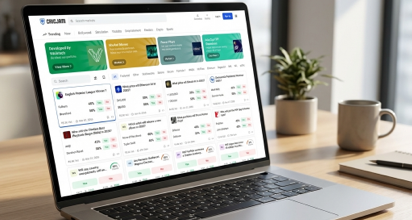
Build a Polymarket or Kalshi-style prediction market in 60 days. Get white-label software, full s...

Discover why global brands are investing in AI-powered fantasy sports app development, white label software, a...

Football brands don’t need more markdowns—especially with World Cup 2026 coming. See how a free-to-play ga...


