How to Choose the Right Prediction Market Vendor
Evaluating prediction market vendors? Discover the 10 non-negotiables for scaling an institutional-grade platform, from hybrid liquidity to AI-driven market creation.

An operator-focused checklist for evaluating a prediction market platform partner
The prediction market industry is undergoing a massive transformation in 2026. What was once a niche corner of the fintech world has become a mainstream mechanism for harnessing collective intelligence, offering real-time forecasts on everything from global elections to tech IPOs and climate events. For operators, this surge in interest brings a critical challenge:
How do you choose a prediction market software provider that can handle institutional-grade scale?
Building a successful event trading platform isn't just about a pretty interface; it’s about the engine under the hood. Choosing the right partner is a long-term strategic commitment that determines your ability to scale, maintain liquidity, and minimize operational overhead.
Below is an elaborate checklist and evaluation guide to help you find the best vendor for your prediction market development.
1) Proof via a working demo
A serious prediction market platform vendor should be able to show a thorough, working demo—not just product screens, wireframes, or “we can build it for you.”
What to look for in a real demo:
-
Market creation → trading → settlement/resolution shown end-to-end
-
Admin controls (market states, scheduling, audit logs)
-
A realistic trading experience (order placement, open orders, positions, price updates)
-
Evidence that the product is already usable, not a prototype
Why it matters: In prediction markets, details are everything: fills, latency, edge cases, and operational workflows. These are hard to “promise” and easy to demonstrate if they exist.
Where Vinfotech stands: We have a working demo you can explore here: https://market.cricjam.com. It’s not a static showcase—we update it regularly, so what you see keeps getting better over time.
2) Gorgeous UX across devices
Prediction markets are an engagement product. If the UI feels clunky, slow, or inconsistent across devices, retention suffers—no matter how good the backend is.
What to evaluate:
-
Is the UX clean and modern (not “exchange-like but confusing”)?
-
Does it work flawlessly on desktop and mobile?
-
Is the browsing experience fast and intuitive?
-
Is the market page designed for real users (not just traders)?
-
Does it feel like something people would use daily?
Why it matters: Operators win when users build a habit. Habit comes from a product that feels smooth, attractive, and easy to use—especially on mobile.
Where Vinfotech stands: Our platform is designed for a clean, modern experience across desktop and mobile, and we treat smoothness and speed as first-class requirements—not add-ons.
3) True multilingual and global launch readiness
Many vendors claim “multi-language,” but real global readiness is broader than translating a few UI labels.
What “true multilingual” usually includes:
-
Full UI translation (including errors, tooltips, and transactional messages)
-
Localization across the journey: product UI, notifications, emails, and templates
-
Regional formats and usability tuning (dates, numbers, naming conventions, UX patterns)
Why it matters: If your ambition is to launch in any country, you want a platform that’s designed for localization—not retrofitted later (which becomes expensive and brittle).
Where Vinfotech stands: We build the platform to be localization-ready from the start, so it can be launched in your target region with the language and market-specific tuning you need. From the product to notifications to emails everything is localized.
4) Overall smoothness of the experience
This is the “non-negotiable” that’s hard to express in requirements but obvious when you use the product. Smoothness is the sum of a hundred small details.
What to look for:
-
Fast, consistent screens and interactions
-
Clean position tracking and P&L clarity (where applicable)
-
No confusing flows when placing/canceling orders
-
A market lifecycle that feels understandable (live → closing → resolved)
Why it matters: Prediction markets compete with every other attention-grabbing product on a user’s phone. If your platform feels heavy or confusing, users don’t come back.
Where Vinfotech stands: We focus heavily on end-to-end smoothness—because in prediction markets, experience quality is what builds daily habit. Please explore the demo to see it for yourself.
5) Liquidity model strength (including AMM from day one)
Early-stage prediction markets often face the same problem: not enough organic liquidity. If users arrive and can’t execute trades smoothly, the product feels “dead,” even if the concept is exciting.
What to check:
-
Do you get AMM from day one?
-
Does the liquidity model help early markets feel usable (without requiring “exchange-scale” volume)?
-
Can the system support a hybrid approach as liquidity matures?
Why it matters: Liquidity is not a “nice-to-have.” It directly affects user trust, conversion, and daily activity—especially at launch.
Where Vinfotech stands: We support AMM from day one, and we also build hybrid approaches (CLOB + AMM) so markets remain usable even while organic liquidity grows.
6) AI-Based Market Creation at Scale
Scaling to thousands of markets manually is not sustainable. A strong vendor should offer AI that generates market questions using web signals, so your exchange stays fresh with minimal operator overhead (AI proposes; humans review/approve).
What to evaluate:
-
Can AI generate markets consistently across categories (sports, crypto, macro, entertainment, etc.)?
-
Does it propose structured outcomes, deadlines, and rule drafts (not just a question)?
-
Is the operator workflow built for scale (review → approve → schedule)?
-
Can you enforce quality filters so AI doesn’t spam low-quality markets?
Why it matters: The best exchanges stay “alive” because there’s always something new to trade. Without scalable market creation, content becomes a bottleneck—and the product stagnates.
Where Vinfotech stands: We’re actively building this “Market Copilot” capability to generate markets at scale with structured rules and operator approval workflows.
7) Growth loops built into the product
Many operators underestimate how important it is to build habit before monetization is pushed aggressively. Growth loops help you acquire users, build repeat usage, and convert at the right time.
What to look for:
-
Free-to-play tournaments and gamified participation loops
-
Mechanisms that encourage daily return visits
-
Engagement structures that work even when users aren’t depositing yet
Why it matters: Free-to-play is often the fastest way to prove engagement, refine categories, and grow repeat usage—before you lean into heavier monetization strategies.
Where Vinfotech stands: We provide free-to-play tournaments and engagement loops as part of the platform approach, because they help operators build repeat usage before pushing monetization aggressively.
8) Sports section as a liquidity surface
Sports is frequently the strongest “daily habit” driver in event trading. It’s live, time-bound, and naturally creates repeat activity.
What to evaluate:
-
A dedicated sports experience (not sports markets mixed randomly with everything else)
-
Sports UX designed for live browsing and quick action
-
The ability to run sports at scale (scheduling, settlement, operations)
Why it matters: A strong sports surface can become a consistent liquidity engine—especially when it’s designed around the live nature of sports.
Where Vinfotech stands: We have developed a dedicated Sports surface as part of the product strategy, since it can become a consistent liquidity and habit engine for many operators. It works different from rest of the product (the game mechanics are the same) and is designed to capture the live nature of sports.
9) Institutional-grade performance and reliability
A prediction market is a real-time system. When volume spikes (big news, big games), performance and stability become your reputation.
What to check:
-
Real-time updates that remain stable under load
-
Throughput capacity and performance goals
-
Monitoring/observability that helps ops teams detect issues fast
-
Overall reliability posture (not just “it works on demo day”)
Why it matters: If the product slows down or feels unreliable during peak moments, you lose trust—and trust is expensive to win back in trading-like systems.
Where Vinfotech stands: Our matching engine and platform are built with institutional performance goals in mind, and we design for high throughput, stable real-time updates, and operator-grade observability.
10) Long-term focus and committed resources
This is the most overlooked factor when choosing a prediction market development company: will the vendor keep improving the platform after launch?
What to evaluate:
-
Is prediction markets a core focus area or “one of many projects”?
-
Are there dedicated product and engineering resources committed long-term?
-
Does the vendor ship continuous improvements (ops tooling, guardrails, UX refinement)?
Why it matters: The biggest wins come from continuous improvement after launch—better guardrails, better ops tooling, and ongoing refinement—so the platform keeps getting stronger as your business grows.
Where Vinfotech stands: Prediction markets are a core focus area for us. We keep investing in the platform—shipping improvements, adding operator tools, and strengthening market-quality guardrails over time.
Final takeaway
If you’re searching for a prediction market vendor, don’t let the decision become a race of feature checkboxes or just price. Use the checklist above to evaluate whether the vendor can deliver the fundamentals at a truly operator-grade level—because that’s what determines long-term success.
If you want a quick reference on how we think about platform maturity, you can also review: https://www.vinfotech.com/resources/prediction-markets/prediction-market-customer-snapshot.
About Vinfotech
Vinfotech builds world-class prediction market solutions like Kalshi or Polymarket. Our proven core engine features battle-tested mechanics with AMM and order book support at a production-ready scale. Whether you need white label or full source code, we provide full customization to meet your specific compliance and operator needs. We also do enterprise prediction markets for internal forecasting. Contact Us today for a demo.

for subscribing to our newsletter.
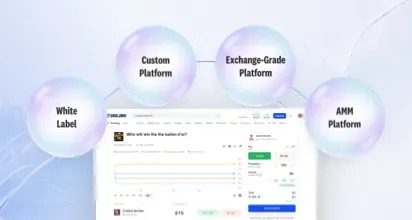
What does it cost to build a prediction market platform in 2026? Discover pricing across white-label solutions...

Understand the difference between a prediction market and a betting platform in simple language. ...

Exploring the US prediction market opportunity? Learn what serious operators should look for in a...
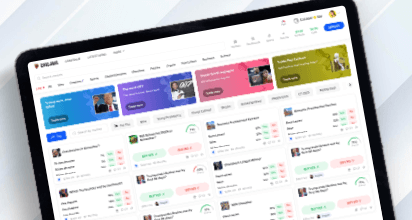
Launch your prediction market business with a white label platform. Get scalable, customizable prediction mark...


