How Much Does It Cost to Build a Prediction Market Platform in 2026? A Realistic Cost Breakdown for White Label, Custom, AMM, and Exchange-Grade Builds
What does it cost to build a prediction market platform in 2026? Discover pricing across white-label solutions, custom builds, AMM, CLOB, and exchange-grade platforms.

Businesses exploring prediction market software in 2026 often start with one direct question: how much does a prediction market platform cost?
It is a fair question. But it is also one of the easiest questions to answer badly.
Many articles online reduce the discussion to a rough number or a broad price range. That may look helpful at first glance, but it usually hides the real issue: prediction market platform development cost depends entirely on what kind of product you are trying to build. A fast-launch white label platform, a deeply customized branded product, a hybrid AMM and CLOB system, and an exchange-grade event trading infrastructure are not the same project. They should not be priced like the same project.
That is why a serious buyer should not look for a random number first. A serious buyer should first understand what drives cost, what adds complexity, what affects scalability, and what kind of infrastructure is truly required for the business model they want to launch.
In this guide, we will break down the major cost drivers behind prediction market platform development in 2026, explain the decisions that shape budget, and help you understand what needs to be scoped before any meaningful pricing conversation can happen.
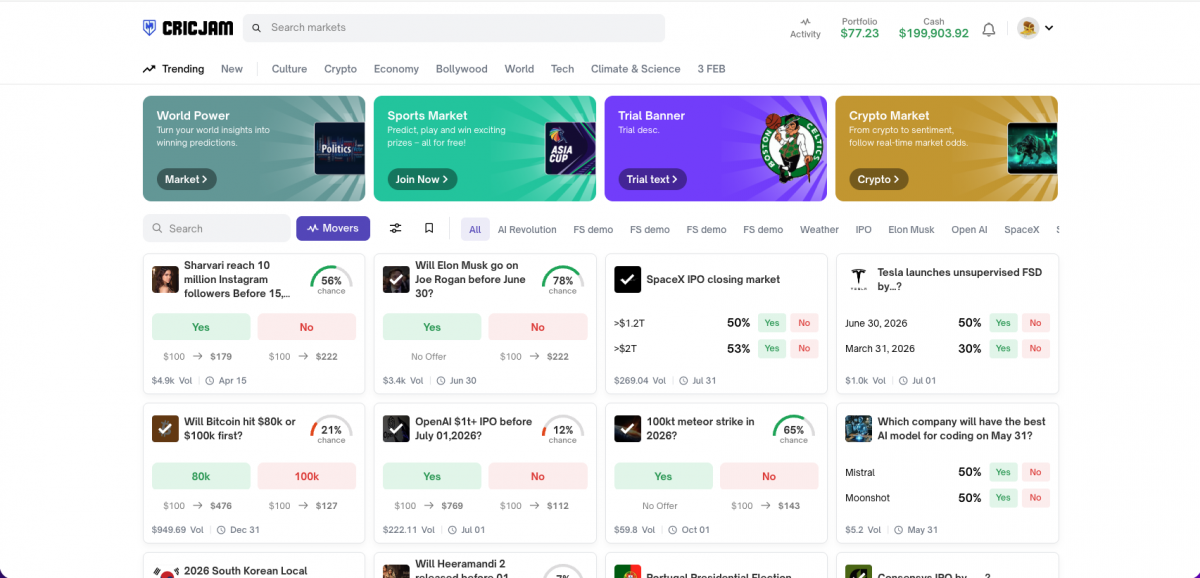
Why prediction market platform cost varies so much
Prediction markets sit at the intersection of trading systems, real-time applications, risk controls, user engagement, and market operations. Because of that, the cost of building one can vary dramatically.
Two buyers may both say they want a "prediction market platform," but their actual requirements may be completely different.
One buyer may want:
-
a white label product
-
branded web and mobile views
-
operator admin
-
basic market creation
-
user wallets
-
deposits and withdrawals
-
standard reports
Another buyer may want:
-
a custom user experience
-
high-frequency order handling
-
advanced matching logic
-
AMM support for thin-liquidity markets
-
a CLOB for mature markets
-
AI-assisted market creation
-
multilingual operations
-
real-time analytics
-
exchange-grade security
-
deep audit trails
-
high transaction readiness
Both are buying into the same broad category, but they are not buying the same system.
That is why the right way to think about prediction market software cost is not as a single number. It is better understood as a function of the product model, infrastructure expectations, security needs, integration scope, and operating complexity.
The first big cost question: white label or custom prediction market platform?
This is usually the first decision that changes the cost structure.
White label prediction market platform
A white label prediction market platform is usually the right choice for businesses that want to launch faster, validate demand, and enter the market with a proven product foundation.
In this model, the core platform already exists. The work usually focuses on:
-
branding and theming
-
payment and wallet setup
-
language support
-
admin configuration
-
market templates
-
deployment setup
-
selected feature adjustments
This route generally reduces time to launch because the business is not paying to reinvent every core system from zero. It also makes sense for companies that want to start with a practical version of the platform and then expand over time.
However, even within white label deployments, cost still changes based on how much you want to modify. A light-touch deployment is very different from a white label solution that requires major custom workflows, special settlement logic, unique account systems, multiple currencies, or a completely redesigned frontend.
Custom prediction market software development
A custom prediction market platform is a different category altogether.
Here, the business usually wants the product to reflect a specific market vision, operating model, user journey, or performance target. This can include:
-
custom frontend and user flows
-
custom market structures
-
specialized trading mechanics
-
operator-specific admin workflows
-
unique compliance checks
-
bespoke reporting layers
-
deep third-party integrations
-
custom notifications and engagement journeys
-
custom mobile experiences
A custom build creates more product control, more differentiation, and often better long-term alignment with the business model. But it also brings higher design complexity, more engineering effort, more testing scenarios, and more operational edge cases.
That naturally changes cost.
Market mechanism is one of the biggest pricing drivers
When people ask about prediction market app development cost, one of the most important hidden variables is the market mechanism.
AMM-based prediction markets
An AMM prediction market is useful when you want markets to feel active even when there is limited natural liquidity. This is especially relevant for free-to-play products, niche categories, low-volume event markets, or early-stage platforms where the biggest challenge is the "empty room" problem.
Adding AMM logic affects cost because it requires careful handling of:
-
pricing curves
-
liquidity logic
-
exposure management
-
slippage behavior
-
market seeding rules
-
trade sizing rules
-
risk controls
-
settlement handling
An AMM can significantly improve usability for early-stage markets, but it is not a cosmetic add-on. It is a core trading mechanic and needs proper architecture.
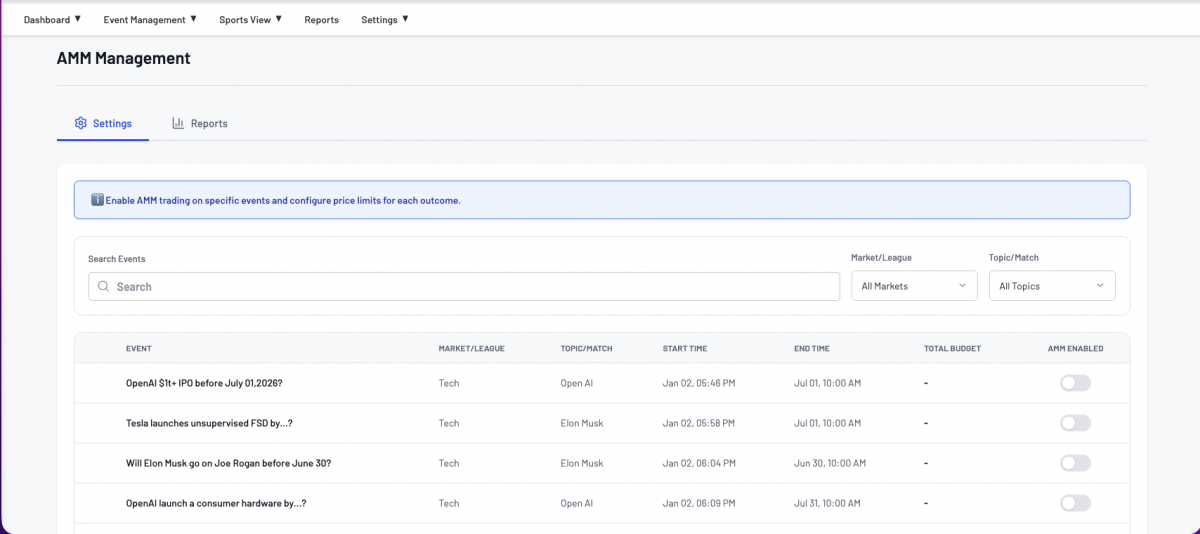
CLOB-based prediction markets
A CLOB prediction market uses an order-book model where users place and match orders against each other. This becomes important when you want:
-
tighter market structure
-
more advanced trading behavior
-
price discovery from user activity
-
mature markets with real order flow
-
exchange-like user experience
A CLOB affects development cost because the platform now needs stronger support for:
-
order entry and cancellation
-
matching engine logic
-
market depth handling
-
websocket streaming
-
concurrency control
-
latency management
-
order lifecycle tracking
-
auditability
Hybrid AMM plus CLOB prediction markets
In 2026, one of the most serious product directions is the hybrid prediction market model, where AMM helps solve liquidity issues in new or inactive markets while CLOB supports more mature and active trading behavior.
This model can be extremely powerful, but it is also more complex to design and operate. The platform must define when and how each mechanism is used, what guardrails apply, and how the user experience stays intuitive across both models.
That is one of the clearest examples of why there is no universal answer to how much a prediction market costs.
Exchange-grade infrastructure changes everything
Many businesses say they want a scalable platform. Fewer take the time to define what that really means.
There is a major difference between:
-
a platform that supports moderate usage
-
a platform designed for serious spikes in activity
-
a platform engineered for exchange-grade transaction handling
If you want a high-performance prediction market platform, cost depends heavily on infrastructure expectations such as:
-
transactions per second
-
concurrent users
-
peak event load
-
real-time order handling
-
websocket performance
-
low-latency architecture
-
event fan-out
-
queueing and failover logic
-
database design
-
caching strategy
-
observability and monitoring
The moment you move toward exchange-grade behavior, the build becomes less like a standard app project and more like specialized financial systems engineering.
This affects architecture, QA, DevOps, security, stress testing, and release discipline. It also affects who should build the platform in the first place.
A company that can design a marketing website or a standard mobile app is not automatically qualified to build a serious event trading engine.
Security requirements have a direct effect on cost
If your platform handles user balances, trading activity, real-time price changes, or sensitive account workflows, security is not a secondary layer. It is a major cost driver.
The depth of security required may depend on your launch model, geography, customer type, and financial flow. Cost changes when buyers expect stronger controls such as:
-
secure authentication flows
-
two-factor authentication
-
account protection controls
-
rate limiting
-
anti-abuse systems
-
wallet security
-
transaction validation
-
admin action logging
-
role-based access control
-
tamper-resistant audit trails
-
infrastructure hardening
-
penetration testing readiness
-
incident monitoring
A lightweight MVP and an enterprise-grade platform cannot carry the same security expectations.
And that is exactly the point. The more serious the platform becomes, the more the cost shifts from simple feature development to platform integrity and risk reduction.
Performance expectations matter more than many buyers realize
A common mistake in scoping is saying: "We want the platform to scale." That sounds right, but it is not enough.
A meaningful pricing discussion needs better questions, such as:
-
How many users may trade during a major event window?
-
How many markets may remain open at once?
-
What order frequency is expected during peak moments?
-
What response time is acceptable for trade placement?
-
How quickly should prices and market state update on the frontend?
-
What failure tolerance is acceptable during a traffic spike?
These decisions affect backend design, websocket architecture, horizontal scaling, queue handling, caching, message delivery, and test strategy.
In short, prediction market platform pricing is deeply linked to performance expectations, not just feature count.
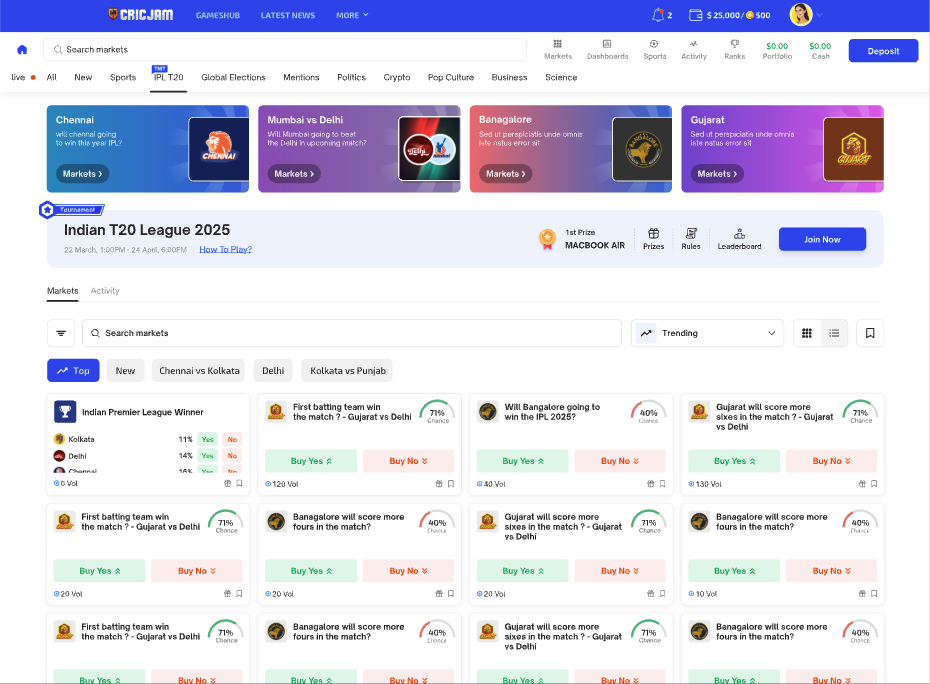
AI modules can significantly change project scope
In 2026, many businesses entering this space are no longer asking only for trading mechanics. They are also asking for AI-assisted market operations.
That can include:
-
AI-based market creator tools
-
event suggestion engines
-
question generation
-
title and market description drafting
-
validation assistance
-
duplicate market detection
-
category tagging
-
operator copilots
-
market moderation support
-
user engagement prompts
An AI market maker or AI market builder module is not the same thing as adding a chatbot to a website. It affects workflow design, prompt engineering, validation layers, human approval flows, admin tooling, data pipelines, and monitoring.
This can create major business value, especially for teams that want to scale market creation without growing operations headcount at the same pace. But it is also a clear scope multiplier and should be treated as such during pricing.
Payments, wallets, fiat, crypto, and token economies all affect cost
A serious prediction market platform may need to handle one or more of the following:
-
fiat payments
-
crypto deposits and withdrawals
-
internal token balances
-
free-to-play coins
-
reward systems
-
hybrid wallet structures
-
bonus logic
-
affiliate accounting
-
financial reporting Each layer adds complexity.
A platform using internal tokens for free-to-play engagement has a very different implementation path compared with one that needs crypto wallet interactions or mixed fiat and token flows.
Even basic questions such as these can change pricing significantly:
-
Are users trading with real money, virtual currency, or both?
-
Do you need a daily rewards loop?
-
Do you need deposit bonuses or promotional balances?
-
Will the operator run one wallet type or several?
-
Do you need multilingual financial reports and accounting views?
These are not side details. They are core product decisions.
Admin and operator tooling are often underestimated
Many buyers focus heavily on the user side and forget that a real business also needs strong operator tooling.
The cost of a platform changes when you need a serious admin layer for:
-
market creation and settlement
-
category and event management
-
user support workflows
-
wallet and transaction controls
-
promotions and campaigns
-
KYC or document review flows
-
multilingual content management
-
FAQ management
-
notifications and email templates
-
affiliate management
-
trading reports
-
financial reconciliation
-
user risk monitoring
-
role-based admin access
A platform that looks good on the frontend but creates chaos in operations is not a mature product.
This is one of the biggest differences between a demo-ready system and a deployable commercial platform.
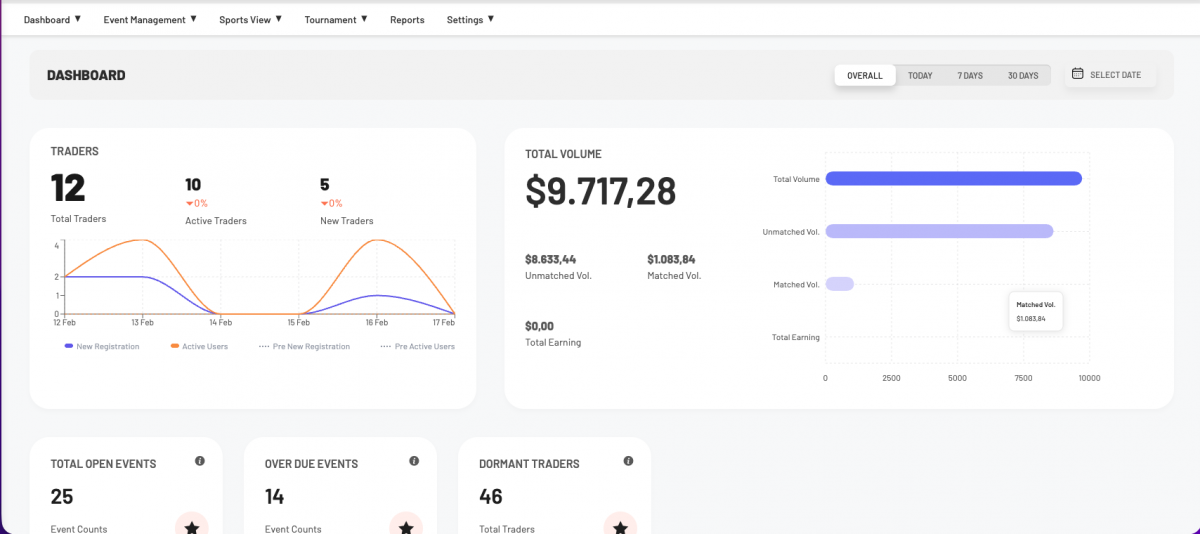
Mobile apps, localization, and multi-region readiness change the scope
Another reason pricing varies is that businesses often say they want a prediction market "platform," but what they really mean is:
-
web platform
-
mobile-responsive experience
-
Android app
-
iOS app
-
multilingual support
-
region-specific wallet or payment integrations
-
timezone-aware market operations
-
local content handling
-
country-specific onboarding requirements
Every additional surface adds testing effort, release management, QA depth, and edge cases.
A prediction market website is one scope. A platform that works beautifully across desktop, tablet, mobile web, Android, and iOS is another.
Integrations can quietly expand the budget
Integrations are one of the most common reasons a project estimate grows during scoping. Examples include:
-
payment gateways
-
crypto infrastructure
-
KYC providers
-
email and SMS providers
-
analytics tools
-
CRM systems
-
affiliate systems
-
identity providers
-
market data feeds
-
internal operator systems
-
reporting exports
Even when the core platform already exists, integration work can be substantial because every provider brings its own logic, edge cases, failure states, testing needs, and operational dependencies.
This is why an experienced prediction market software company will always ask detailed integration questions before giving a serious quote.
Hidden cost drivers buyers often miss
Some of the most important pricing drivers are not visible in a feature checklist.
These include:
Market operations complexity
Who creates the markets? How are they reviewed? How are they settled? What happens when an event source is delayed or disputed? What audit trail is required?
QA and testing depth
Real-time systems need more than standard happy-path testing. They require performance testing, failure-state testing, concurrency testing, and release discipline.
Data model quality
Poor event structure, weak category design, or inconsistent market metadata can create long-term operational pain.
Observability and support readiness
Serious platforms need logs, alerts, monitoring, and enough operational visibility to detect issues before users do.
Upgrade path
A buyer may start with a simpler version of the platform but want the architecture to support future modules such as hybrid AMM, AI tooling, advanced analytics, or exchange-grade optimization.
If the initial system is not designed with that future in mind, the long-term cost becomes much higher.
A practical way to think about prediction market cost in 2026
Instead of asking for one generic number, it is better to place your project into a business scenario.
Scenario 1: Fast-launch white label prediction market
This is suitable for businesses that want speed, lower initial complexity, and a proven base product. The cost depends on how much branding, configuration, wallet setup, and feature adjustment is required.
Scenario 2: White label plus meaningful customization
This is common when a company wants the advantage of an existing core platform but still needs significant changes to workflows, UI, market structure, or reporting.
Scenario 3: Custom branded prediction market product
This is suitable for businesses that see prediction markets as a strategic product line and want stronger control over experience, operations, and differentiation.
Scenario 4: Hybrid AMM and CLOB product
This is appropriate when liquidity design, trading depth, and user experience need more sophistication than a one-mechanism platform can provide.
Scenario 5: Exchange-grade prediction market infrastructure
This is the serious end of the spectrum. It applies when scale, throughput, low latency, resilience, security, auditability, and market integrity become central to the product vision.
Each scenario has a different cost logic. That is why serious vendors do not quote responsibly without first understanding the business model and technical expectations.
Questions you should answer before asking for pricing
If you want a more accurate understanding of your likely budget, answer these questions first:
-
Do you want a white label prediction market platform or a custom-built one?
-
Are you planning a free-to-play product, a real-money product, or a hybrid model?
-
Do you need AMM, CLOB, or a hybrid market mechanism?
-
How important are throughput, latency, and concurrent trading performance?
-
Do you need web only, or web plus Android and iOS apps?
-
Which payment, wallet, or crypto flows need to be supported?
-
Do you need AI-based market creation or AI-assisted market operations?
-
How much admin control, reporting depth, and operator tooling do you need?
-
Which integrations are mandatory at launch?
-
How serious do your security and audit requirements need to be?
Once these answers are clear, the pricing conversation becomes far more meaningful.
What serious buyers should really look for in a vendor
When evaluating prediction market development companies, price should not be the only factor. The right vendor should understand:
-
trading system behavior
-
market operations
-
real-time architecture
-
wallet and payment complexity
-
scalability requirements
-
admin workflows
-
engagement design
-
future module extensibility
-
performance and security tradeoffs
The best vendor is not the one that gives the lowest quote in the first meeting. The best vendor is the one that scopes correctly, asks the right questions, identifies what matters for your business model, and builds with long-term stability in mind.
How Vinfotech approaches prediction market platform scoping
At Vinfotech, we believe the right way to price a prediction market platform is to first understand the business behind it.
That means looking at:
-
your target market and launch geography
-
whether you want white label or custom development
-
whether you need AMM, CLOB, or hybrid logic
-
the role of fiat, crypto, or token economies
-
expected performance and trading activity
-
operator workflows and admin depth
-
mobile and multi-language scope
-
AI module expectations
-
integration and deployment needs
-
long-term product roadmap
Only after that can pricing become meaningful.
This approach is better for buyers because it prevents under-scoping, unrealistic estimates, and expensive rework later. It also helps ensure that the final platform matches your business model rather than forcing your business to fit a generic product template.
Final thoughts: the real cost of a prediction market platform depends on what you are truly building
So, how much does it cost to build a prediction market platform in 2026?
The honest answer is this: there is no serious universal number, because there is no single universal product.
A white label launch, a custom event trading platform, a hybrid AMM and CLOB solution, and an exchange-grade market infrastructure are four very different projects. The right cost depends on what kind of product you want to launch, how you expect it to perform, what market mechanics you need, how strong your security must be, and how much operational sophistication you expect from day one.
That is why the smartest first step is not chasing a generic estimate. It is getting the architecture, feature scope, and operating model clarified properly.
If you are exploring prediction market platform development, white label prediction market software, or a more advanced exchange-grade prediction market build, Vinfotech can help you scope the right product path and align pricing with the actual business need.
Frequently Asked Questions
Why is prediction market platform cost so hard to standardize?
Because cost depends on the platform model, market mechanism, performance expectations, security depth, payment flows, admin tooling, integrations, and long-term roadmap.
Is a white label prediction market platform cheaper than a custom build?
In most cases, yes, because the core product foundation already exists. But the final scope still depends on how much customization and integration is required.
Does AMM increase prediction market development cost?
Yes. AMM changes the trading logic of the platform and requires additional work around pricing behavior, liquidity design, slippage rules, and exposure controls.
Does exchange-grade infrastructure make a big difference in cost?
Absolutely. Once the platform must handle serious throughput, concurrency, low latency, resilience, and auditability, the architecture becomes much more specialized.
Should I ask for pricing before finalizing my feature scope?
You can ask for a directional discussion, but meaningful pricing usually becomes possible only after the vendor understands your product model, market mechanics, security expectations, integration needs, and scale goals.
About Vinfotech
Vinfotech builds world-class prediction market solutions like Kalshi or Polymarket. Our proven core engine features battle-tested mechanics with AMM and order book support at a production-ready scale. Whether you need white label or full source code, we provide full customization to meet your specific compliance and operator needs. We also do enterprise prediction markets for internal forecasting. Contact Us today for a demo.

for subscribing to our newsletter.

Understand the difference between a prediction market and a betting platform in simple language. ...

Exploring the US prediction market opportunity? Learn what serious operators should look for in a...
Launch your prediction market business with a white label platform. Get scalable, customizable prediction mark...

Discover why free-to-play prediction market games are becoming a powerful engagement layer for sp...


